Eight Billion Hamlets
A few weeks ago, during an online improv session, my scene partner opened by telling me about something he was suffering through. I chuckled. I had not planned it; it just happened. He kept going, and the worse his troubles got, the harder I laughed. The group caught on. Next, someone tagged me out, stepped in as a very serious therapist, listened for a while, and slowly lost it into laughter too.
As an unlikely response to a man describing his pain, the laugh was funny because it broke the pattern everyone expected. My teammates reinforced the game and the funny got bigger. Any system tuned toward the probable, “right” answers would rarely reach for it unprompted. My chuckle came from a library of experiences applied to a precise opportunity without forethought.
That small, unpredictable laugh is at risk in a world of AI-driven answers.
The tomato problem
For decades, tomato breeders selected for fruit that ripened evenly, turned a uniform red, and shipped well to supermarkets. In 2012, researchers writing in Science (Powell and colleagues, June 2012) identified the gene behind that uniform ripening, and found that the very trait breeders prized also dampened the fruit’s ability to build sugar and flavor. Nobody set out to make tomatoes taste worse. They optimized for consistency, and flavor paid the bill.
Nobody died, tomato sales are fine, and there was no robot uprising. However, a slow, reasonable, well-intentioned drift toward the middle continues until one day a person bites into an heirloom tomato and wonders what happened.
Eight billion Hamlets
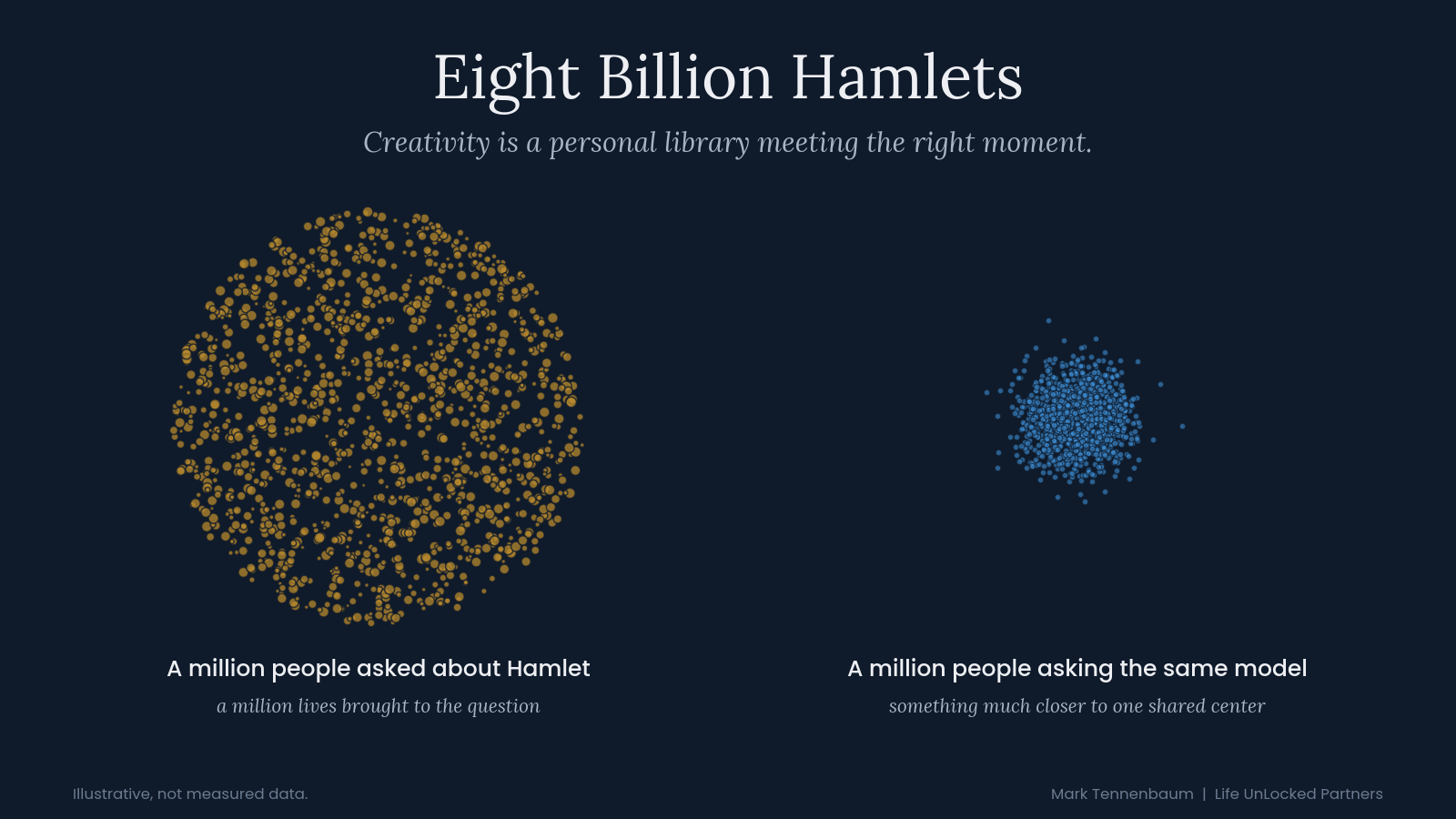
Say “Hamlet” to a room full of people and every one of them hears something different. One remembers a performance seen at twenty. Another remembers a father, a grudge, a question about why the prince waits so long. A third remembers nothing but the skull. No two people store the play the same way, because human memory does not simply file facts. It compresses a life into stories that are unique to each person, and it recalls those stories a little differently each time.
Even the same person changes. At 18, I could not appreciate fine wine the way I could by my 40s, after years of tasting, reading, and adjusting. Reread Hamlet at sixty and the play has not changed, but the reader has. Nobody, including the reader, possesses quite the same library twice.
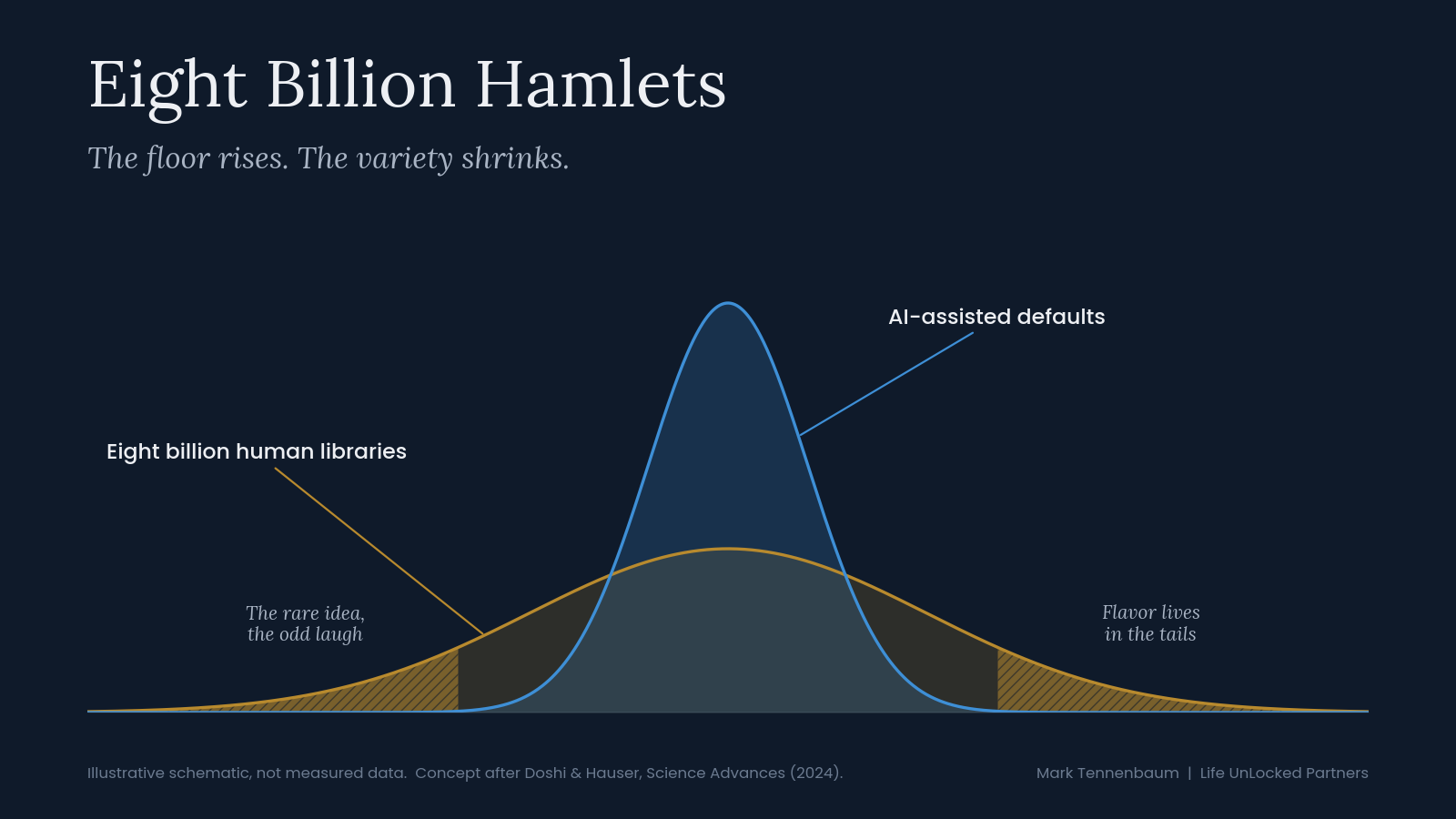
That, I think, is what creativity actually is: recombination across a uniquely encoded library. The improv laugh, the odd business idea, the investment thesis everyone else dismissed, all come from somebody connecting two things that only they happened to be carrying when a moment arises. Eight billion people means eight billion slightly different Hamlets, and eight billion slightly different libraries from which to draw. That variety is the raw material of every great leap.
Already on the menu
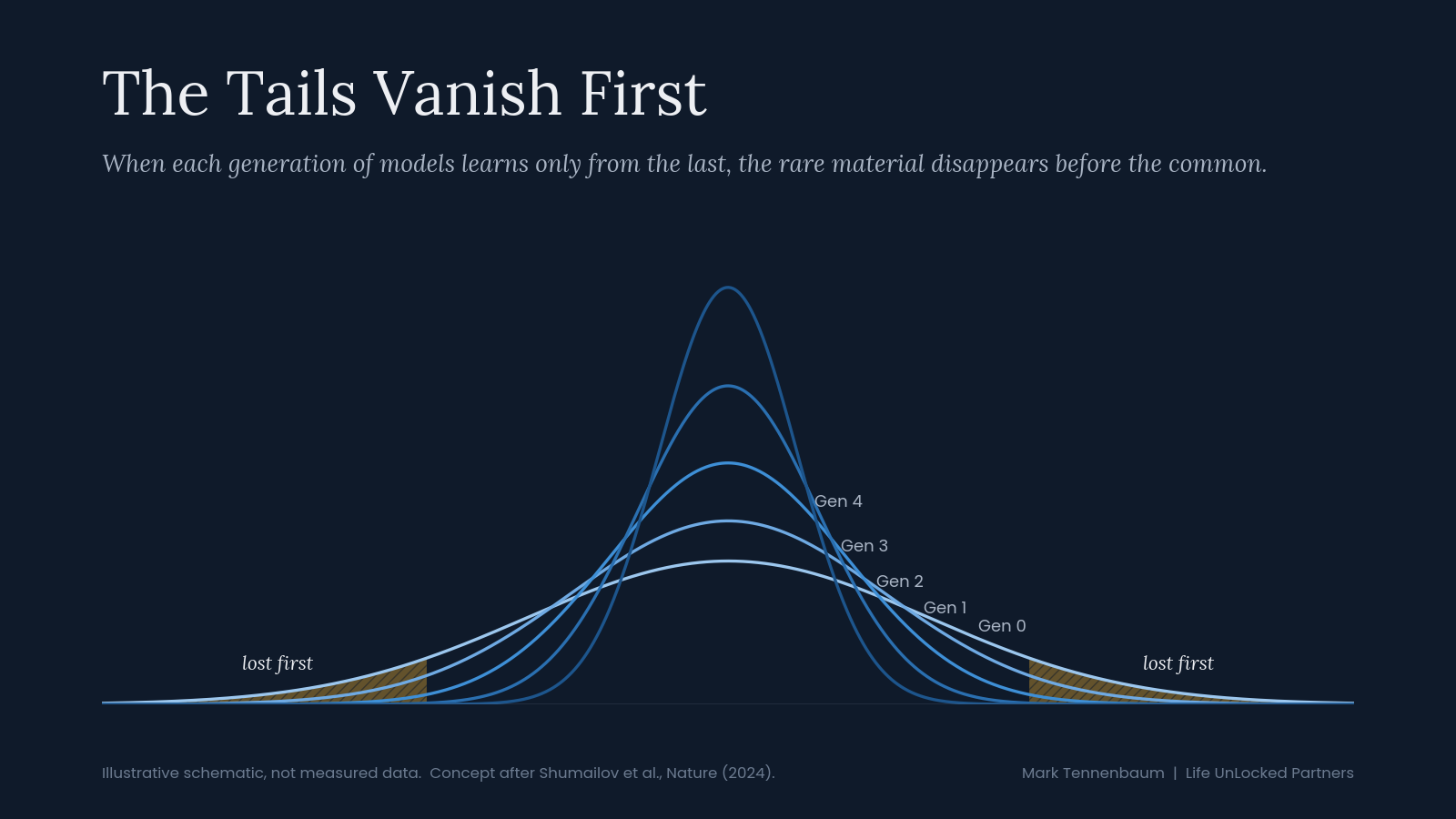
The narrowing has started to show up in places anyone can see. After ChatGPT arrived, the word “delve” surged in biomedical papers, along with a small family of other suddenly fashionable words (Kobak and colleagues, Science Advances, 2025). Researchers at Cornell found that AI writing suggestions nudged Indian participants toward American phrasing and away from their own cultural references (Agarwal, Naaman, and Vashistha, CHI 2025). The tool did not tell anyone to sound American. It simply suggested the most typical way to say things, and its sense of typical reflects the data and the raters it learned from.
None of this began with AI. Kyle Chayka described in his 2024 book Filterworld how recommendation algorithms helped make coffee shops from Brooklyn to Seoul look interchangeable: reclaimed wood, Edison bulbs, the same latte art. I have nothing against Edison bulbs. But AI extends that same gentle pressure from what we look at to what we write, design, and think.
Therein lies the flavor problem. Sadly, most people will never notice, and that is exactly the point: flavor only becomes noticeable at the moment someone tastes the thing that was lost.
The fair objection
For balance, let’s examine the opposite case. A single Doshi and Hauser experiment, using short stories and a 2023 model, is not a law of nature. In the same study, the most creative writers gained little from AI, but they were not flattened either. An outlier using these tools can become more of an outlier. Lower barriers also mean far more people creating, so total variety could rise even as each individual piece drifts toward the middle. And humans have managed plenty of homogenization without help: a film franchise, the open-plan office, the café with the Edison bulbs.
I accept all of it. The narrowing is a default, not a destiny. These systems lean toward the most typical answer unless someone pushes them elsewhere, and most people, most of the time, will not push. I use these tools nearly every day, and the pull toward the middle is real: the first suggestion is almost always the reasonable one. Reasonable works for an invoice. It ruins an idea.
Why investors should care
If narrowing costs flavor in our culture, it may well increase risk for investors.
If every analyst drafts the same thesis with the same models, then consensus thickens, trades crowd together, and the exits narrow at the same moment. We saw this in August 2007 when quantitative funds running similar models had crowded into similar positions. When a few began to sell, the rest took heavy losses within days, an episode Amir Khandani and Andrew Lo later dissected in “What Happened to the Quants in August 2007?”
The return available from agreeing with everyone else is, more or less, the market’s, and an overly crowded view becomes a more volatile one.
On the other hand, a return from a genuinely differentiated view that proves right often comes from the tails of the opinion distribution that AI models tend to trim. In a world of shared Hamlets, an investor’s own Hamlet can prove more valuable in the right hands.
Businesses face the same arithmetic. A company whose marketing, strategy memos, and product ideas all come from the same first draft as its competitors’ will sound like them, and eventually price like them. Distinctiveness is a defensible moat against the middle of the bell curve, where overcrowding is worst.
Keeping the flavor
None of this argues for abandoning the tools. It argues for using them the way a good chef uses a sous-chef: for speed, prep, and consistency, while the menu stays personal. A few habits help.
Write the strange idea down before asking the machine. Treat the first answer as the center of gravity, not the edge. Ask for the outlier on purpose, then judge it with a palate built over years. And keep people with unusual libraries in the room: the colleague with the odd background, the client who buried his savings because of something his grandfather said, the improviser who laughs at exactly the wrong moment.
Back to the scene
That improv scene only worked because a group of people recognized a move worth reinforcing, and we paid off the weird idea.
Eight billion people, eight billion Hamlets, each one a little messy, a little inconsistent, and entirely our own. The tools will keep getting better at the middle of the curve. The tails are still ours to keep.